A Taste of Greece
Smooth to drink, yet strong. With the distinctive flavour of aniseed and the very essence of Greece. It is clear, yet when water is added it turns cloudy, taking on a milky hue and allowing its aromas to unfold, revealing an entirely different character. It lifts your spirits at once, but if you overindulge, it can catch up with you before you know it. A drink for company, sociability and heartfelt conversation. And all the better when accompanied by tempting little meze dishes.
Ouzo is Greece’s quintessential drink and originates from Asia Minor. Today, it is traditionally produced on Chios, in Northern Greece, and of course on Lesvos.
Its production is a complex, meticulous and time-honoured process. Each recipe is often passed down from generation to generation as a closely guarded family secret. Ouzo is flavoured with a variety of herbs from the Greek land, such as coriander, fennel, star anise, moss rose, angelica root, and with simple aniseed holding pride of place.
Fermentation takes place in traditional, handcrafted copper stills, where the alcohol, seeds and aromatic ingredients remain for hours. The mixture is then distilled, and from this first distillation the “heart” is carefully selected—the most flavourful part of the distillate. This is followed by a second and third distillation, during which it is continuously monitored and tasted. The final distillate is left to rest, allowing the elements and aromas to harmonise into a balanced, homogeneous blend. Before bottling, it is diluted with water to reach the desired alcoholic strength, which by law must be no less than 37.5% vol.
Unlike tsipouro, ouzo is typically made with only a small proportion of distilled grape spirit—at least 20%, as required by law. However, some varieties are produced using higher percentages. Today, there are more than 300 ouzo producers across Greece.
Ouzo is enjoyed neat, diluted with water, or over ice. It is traditionally served in a tall, slender glass, allowing you to add as much water as you like. It also serves as a base for refreshing summer cocktails, combined with fruit or vegetable juices and liqueurs. Some aficionados alternate sips of ouzo with Greek coffee, while others even add a few drops directly to their coffee.
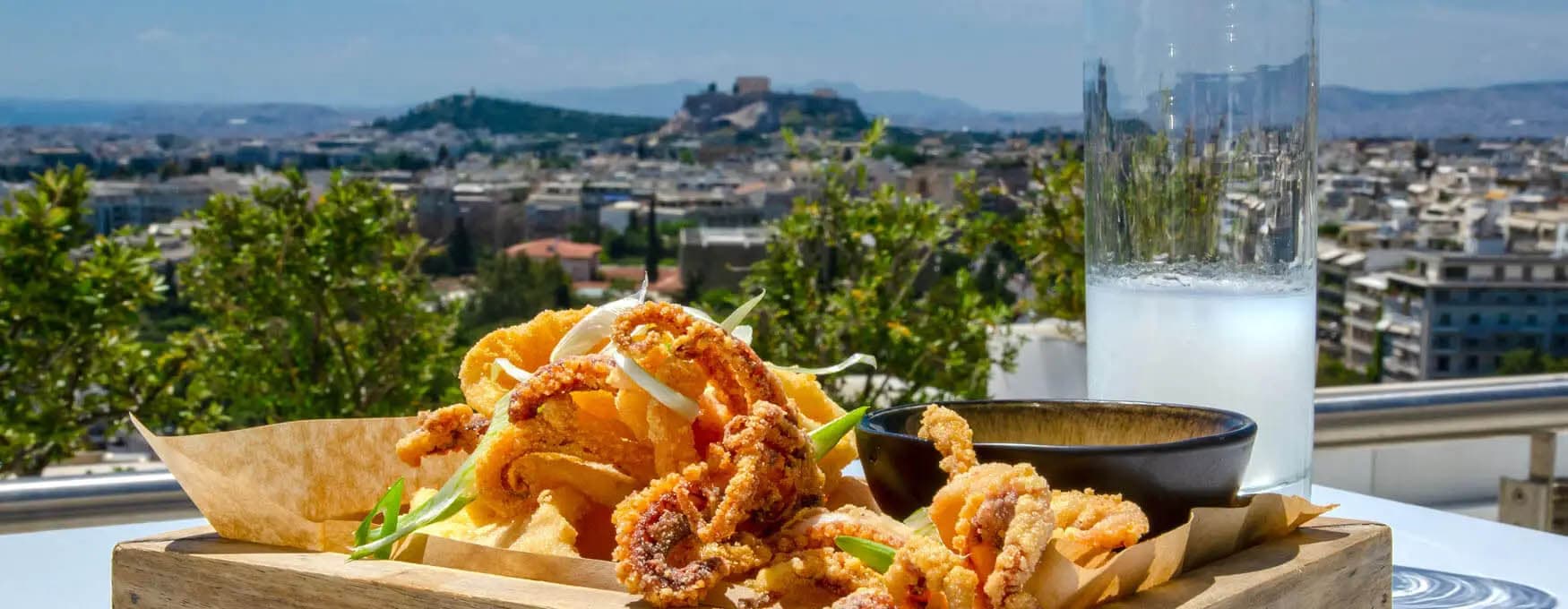
Ouzo is never meant to be drunk on its own. It whets the appetite and calls for meze. It pairs beautifully with seafood, cured fish and cold cuts—you’ll soon find how it brings out the flavours of each. And of course, ouzo is best enjoyed in good company. It lifts the mood instantly; tongues loosen, and conversation and laughter flow without end. And the perfect place to savour it? Somewhere by the sea. Ouzo is inseparable from the Greek summer and the coast.
Cheers!
Smooth to drink, yet strong. With the distinctive flavour of aniseed and the very essence of Greece. It is clear, yet when water is added it turns cloudy, taking on a milky hue and allowing its aromas to unfold, revealing an entirely different character. It lifts your spirits at once, but if you overindulge, it can catch up with you before you know it. A drink for company, sociability and heartfelt conversation. And all the better when accompanied by tempting little meze dishes.
Ouzo is Greece’s quintessential drink and originates from Asia Minor. Today, it is traditionally produced on Chios, in Northern Greece, and of course on Lesvos.
Its production is a complex, meticulous and time-honoured process. Each recipe is often passed down from generation to generation as a closely guarded family secret. Ouzo is flavoured with a variety of herbs from the Greek land, such as coriander, fennel, star anise, moss rose, angelica root, and with simple aniseed holding pride of place.
Fermentation takes place in traditional, handcrafted copper stills, where the alcohol, seeds and aromatic ingredients remain for hours. The mixture is then distilled, and from this first distillation the “heart” is carefully selected—the most flavourful part of the distillate. This is followed by a second and third distillation, during which it is continuously monitored and tasted. The final distillate is left to rest, allowing the elements and aromas to harmonise into a balanced, homogeneous blend. Before bottling, it is diluted with water to reach the desired alcoholic strength, which by law must be no less than 37.5% vol.
Unlike tsipouro, ouzo is typically made with only a small proportion of distilled grape spirit—at least 20%, as required by law. However, some varieties are produced using higher percentages. Today, there are more than 300 ouzo producers across Greece.
Ouzo is enjoyed neat, diluted with water, or over ice. It is traditionally served in a tall, slender glass, allowing you to add as much water as you like. It also serves as a base for refreshing summer cocktails, combined with fruit or vegetable juices and liqueurs. Some aficionados alternate sips of ouzo with Greek coffee, while others even add a few drops directly to their coffee.
Ouzo is never meant to be drunk on its own. It whets the appetite and calls for meze. It pairs beautifully with seafood, cured fish and cold cuts—you’ll soon find how it brings out the flavours of each. And of course, ouzo is best enjoyed in good company. It lifts the mood instantly; tongues loosen, and conversation and laughter flow without end. And the perfect place to savour it? Somewhere by the sea. Ouzo is inseparable from the Greek summer and the coast.
Cheers!


